Sunday, June 3, 2007


9. Animal based food

The larger category here is meat based foods, whether animal or fish, or their derivatives like milk-based butters or animal fat oils.
A book on our innate "bioregional diet" as important to resuscitate for our own health is Why Some Like it Hot: Food, Genes, and Cultural Diversity, by Gary Paul Nabhan
From Publishers Weekly
With 21st-century science promising better living through genetic engineering, and myriad diet fads claiming to be the answer to obesity and disease, this exploration of the coevolution of communities and their native foods couldn't be more timely. Ethnobiologist Nabhan (Coming Home to Eat) investigates the intricate web of culture, food and environment to show that even though 99.9% of the genetic makeup of all humans is identical, "each traditional cuisine has evolved to fit the inhabitants of a particular landscape or seascape over the last several millennia." Sardinians are genetically sensitive to fava beans, which can give them anemia but can also protect them from the malaria once epidemic in the region. Navajos are similarly sensitive to sage. [Other cultural regions--of food, genes, and culture over time--thus build animal fats into diets as why people some people are healthy on these diets and others less so.] In both cases, traditional knowledge allows safe interactions with these powerful medicine/poisons through cooking methods or food combinations. Nabhan questions the wisdom of genetic therapy, which "normalizes" the "bad" genes that can cause sickness but also enhance immunity. Most inspiring in this bioethnic detective story are Cretans, maintaining their health for centuries through traditional living, and Native Americans and Hawaiians, whose communities, devastated by diabetes, find an antidote by returning to their traditional foods, customs and agriculture. Mixing hard science with personal anecdotes, Nabhan convincingly argues that health comes from a genetically appropriate diet inextricably entwined with a healthy land and culture.
From Booklist:
Ethnobotanist and nutritional ecologist Nabhan continues the paradigm-altering investigation into the matrix of food, place, ethnicity, and well-being that he's been conducting in such influential books as Coming Home to Eat (2002). A leading voice in the slow-food movement and a thoroughly engaging guide, Nabhan now delineates the evolutionary dimension of newly recognized interactions among cuisine, culture, and genetics that inspired him to modify an old adage: "We are what our [recent regional instead of ancient paleolithic!] ancestors ate and drank." He teases out the evolutionary secrets of chili peppers and explains why some folks like them hot and others can't take the heat. Since it's easiest to see the hidden benefits of ethnic cuisines in isolated island societies, he travels to Sardinia, where, for centuries, fava beans have protected the populace from malaria, and to Hawaii, where natives have discovered that traditional yet neglected taro dishes control diabetes [in their genotypes best]. With millions [really the majority of the world, he writes] of people suffering from little-understood food-related maladies, Nabhan's revelations of the complexities of our [regionally] inherited interactions with food, the true significance of the healthful "synergies" of traditional ethnic cuisines, and the essentiality of both biodiversity and cultural diversity are as critical as they are fascinating.
Therefore, beware the industrial pressures that attempt to avoid your 'bioregional diet' of traditional regional foods, many of them (not all!) high in animal fats. Ms. Fallon describes the U.S. as the worst case scenario of powerful industrial destruction of bioregional dietary standards, where diet and scientific knowledge is sculpted or perverted to be advertising for industrial profit instead of for health:
The Oiling of America, by Mary Fallon (of the Weston Price Foundation, discussing Dr. Mary Enig's (Ph.D., medicine) research on animal fats, cholesterol, and industrial food's perversions of scientific studies on health
2:03:00 min
"Margarine is the bad guy and butter and eggs are the good guys [for certain regional foodways--see Nabhan's book above.] For fifty years, big business, government agencies and medical organizations have campaigned deceptively against animal fats, meat, eggs, butter and other nutritious, traditional foods, leading to huge profits from the sale of toxic margarine, shortenings and liquid vegetable oils, and the foods that contain them [because these have greater profit margin potentials for large scale suppliers than the others]. Scientific data contradicting current anti-animal fat public health policy was suppressed and censored for many years. Dr. Enig and Sally Fallon now tell you the truth about how that happened. The Oiling of America will open your eyes to fraud and deception behind the lipid hypothesis of heart disease. Topics include:
* How scientists cheat in scientific studies
* Why cholesterol is not the cause of heart disease
* The dangers of cholesterol-lowering diets and drugs
* Why trans fatty acids and [the industrial chemical processing techniques of many] liquid vegetable oils are [making them] so dangerous to human health."
With Fallon and Nabhan in mind, let's go to the sea, next:
Dan Barber: How I fell in love with a fish
19:02 min.
Chef Dan Barber squares off with a dilemma facing many chefs today: how to keep fish on the menu. With impeccable research and deadpan humor, he chronicles his pursuit of a sustainable fish he could love, and the foodie's honeymoon he's enjoyed since discovering an outrageously delicious fish raised using a revolutionary farming method in Spain.
And open-ocean farmed fish is unsustainability incarnate, with a host of dangers to the local communities of people and ecologies where it has been destructive worldwide. Avoid farmed fish. Why? Watch this four part documentary of its effects:
Farmed Salmon Exposed (1/4)
3:26 min
A short documentary by the Pure Salmon Campaign--though what they say applies to the devastating effects of open-ocean farmed fish in general.
In the name of maintaining biodiversity, the Slow Food Movement of institutionalizing biodiversity and varietals is a far more long term and far more sound model for health, ecology, and economy--than cloned cattle.
"The Slow Food movement was created to combat fast food and claims to preserve the cultural cuisine and the associated food plants and seeds, domestic animals, and farming within an ecoregion. It was the first established part of the broader Slow movement. The Slow Food movement was founded by Carlo Petrini in Italy as a resistance movement to fast food. It has since expanded globally to 100 countries and now has 83,000 members."
Since in the bioregional state the local jurisdictional autonomy on economic developmental path decisions is the primary jurisdiction, decisions like this along the model of 'does it fit where we live?' will be far more instrumental for setting commodity policy in a watershed. This is already seen in the many county level governments and states that have institutionalized much higher local levels of human health-ecological health protection concerning commodities, than federal baselines.
Thus, decisions on all commodities will be up to particular local watersheds, a model of state more akin to modeling biodiversity and ecological variegation as the purpose of the state to protect and maintain, instead of destroy. However, this fails to mean that large scale baseline standards laws (or laws to outlaw) certain commodity uses and merely supply-side uses will disappear from larger jurisdictions. These will only be baselines of human health, ecological, and economic sustainability local protection though, in all cases, instead of attempts to make multiple local areas suffer under larger federal 'glass ceilings laws' attempting to stop local health, ecological, and economic protection from going higher, when the public in that area wants it.
In this movement toward material sustainability, I can think of nothing more appropriate than [1] to demote supply-side biased agricultural monocropping and its recent budded-off twin, [2] to demote supply-side biased cloned animal strategies. Both have always been short term evil twins against local long term ecological, health, and economic durability. They are evil twins organizationally speaking because they are interwoven in massive pollution/externality streams connected via monocropping feedstocks for such 'animal monocropping.'
In this category of 'animal based food,' the Slow Food Movement encouraging local varietal use and maintenance is far more important to institute with commodity ecology interactions.
Seven Arguments Against Cloned Animals
Arguments against cloned animal monocropping are very numerous and interrelated to health, biodiversity/ecological, and economic sustainability issues:
[1] Clones cannot be perfect copies.
"...clones are far from perfect copies. All clones are defective, in one way or another, with multiple flaws embedded in their genomes. Rudolf Jaenisch, a geneticist at the Massachusetts Institute of Technology, estimates that something like 4-5% of the genes in a cloned animal's genome are expressed incorrectly.
[2] Clone and human health difficulties arising from clones get transferred into the food chain: you.
"These often subtle genetic defects can have tangible consequences. Cloning produces an extraordinarily high number of deaths and deformed animals. Some clones have been born with incomplete body walls or with abnormalities in their hearts, kidneys or brain function, or have suffered problems like "adult clone sudden death syndrome" and premature ageing."
[3] Without the data on its safety at all, it is only another open air experiment on your health, thanks to the corrupt FDA--just like their corrupt open air experiment without notification concerning GMOs.
"...who knows how this is transferred to YOU. Nothing has been done in research on these issues of long term exposure.
[4] Cloned animals demote biodiversity.
[5] Cloned animals encourage agricultural 'shakeout' or agricultural/stock consolidation land tenures, which become more prone to externalities (like factory farming large scale arrangements).
[6] In practice, cloned animals would yield more health dangers to you from wider 'monocropped animals' in factory farm conditions, with more loads of crowd diseases risk, stress, and antibiotics given to them all the while, which gets transferred to you as well, as well as leads to pathogens becoming immune to antibiotic treatment.
[7] It's against the animals themselves.
In general, the added risks and lack of similarity in cloned meat is anti-consumer and anti-animal on every level.
As mentioned in the Commodity Ecology title page, institutions on the watershed level (CDIs and commodity ecology) help facilitate this changeover, equitably and sustainably, for the iterative long term. It is very similar to the goals of the Slow Food Movement.

[Slow Food Snail with Green Phrygian Cap]
The bioregional state in many ways, from the point of view of animal/vegetable varitals, the state formation implications or component of the Slow Food Movement:
The Slow Food movement incorporates a series of objectives within its mission, including:
* forming and sustaining seed banks to preserve heirloom varieties in cooperation with local food systems
* developing an "ark of taste" for each ecoregion, where local culinary traditions and foods are celebrated
* the preservation and promotion of local and traditional food products, along with their lore and preparation
* the organization of small-scale processing (including facilities for slaughtering and short run products)
* the organization of celebrations of local cuisine within regions (e.g. the Feast of Fields held in some cities in Canada)
* Taste Education
* educating consumers about the risks of fast food
* educating citizens about the drawbacks of commercial agribusiness and factory farms
* educating citizens about the risks of monoculture and reliance on too few genomes or varieties
* Various political programs to preserve family farms
* Lobbying for the inclusion of organic farming concerns within agricultural policy
* Lobbying against government funding of genetic engineering
* Lobbying against the use of pesticides
* Teaching gardening skills to students and prisoners
* Encouraging ethical buying in local marketplaces
Building those two institutions of commodity ecology and CDI in all watersheds will aid in making commodity uses streamlined and optimized in particular watershed areas as well as encourage local democratization--instead of merely watching corrupt governments institutionalize biased commodity uses against local health, the ecology, and against the sustainability of the economy itself.
10. Vegetable based food

DENUTRIFIED FOOD AND INDUSTRIAL AGRICULTURE
Recently, it has been noted that Americans are shrinking--as junk food and denutrified food takes its toll.
"Poverty and poor diet mean the average US man is getting smaller, while Europeans keep growing taller
http://www.guardian.co.uk/usa/story/0,12271,1185457,00.html
Researchers have made a startling discovery: Americans are shrinking. A nation once famed for its strapping, well-nourished youth is gradually diminishing in physical stature." Of course, it's only Americans shinking, as the rest of the world continues to grow. Why? The U.S. has rejected health for industrial production in many food products and the lies of big medicine that ignore industrial production kills food, with suffering of the population, the soil, and the economy as a result.
A book on our innate "bioregional diet" as important to resuscitate for our own health is Why Some Like it Hot: Food, Genes, and Cultural Diversity, by Gary Paul Nabhan
From Publishers Weekly
With 21st-century science promising better living through genetic engineering, and myriad diet fads claiming to be the answer to obesity and disease, this exploration of the coevolution of communities and their native foods couldn't be more timely. Ethnobiologist Nabhan (Coming Home to Eat) investigates the intricate web of culture, food and environment to show that even though 99.9% of the genetic makeup of all humans is identical, "each traditional cuisine has evolved to fit the inhabitants of a particular landscape or seascape over the last several millennia." Sardinians are genetically sensitive to fava beans, which can give them anemia but can also protect them from the malaria once epidemic in the region. Navajos are similarly sensitive to sage. [Other cultural regions--of food, genes, and culture over time--thus build animal fats into diets as why people some people are healthy on these diets and others less so.] In both cases, traditional knowledge allows safe interactions with these powerful medicine/poisons through cooking methods or food combinations. Nabhan questions the wisdom of genetic therapy, which "normalizes" the "bad" genes that can cause sickness but also enhance immunity. Most inspiring in this bioethnic detective story are Cretans, maintaining their health for centuries through traditional living, and Native Americans and Hawaiians, whose communities, devastated by diabetes, find an antidote by returning to their traditional foods, customs and agriculture. Mixing hard science with personal anecdotes, Nabhan convincingly argues that health comes from a genetically appropriate diet inextricably entwined with a healthy land and culture.
From Booklist:
Ethnobotanist and nutritional ecologist Nabhan continues the paradigm-altering investigation into the matrix of food, place, ethnicity, and well-being that he's been conducting in such influential books as Coming Home to Eat (2002). A leading voice in the slow-food movement and a thoroughly engaging guide, Nabhan now delineates the evolutionary dimension of newly recognized interactions among cuisine, culture, and genetics that inspired him to modify an old adage: "We are what our [recent regional instead of ancient paleolithic!] ancestors ate and drank." He teases out the evolutionary secrets of chili peppers and explains why some folks like them hot and others can't take the heat. Since it's easiest to see the hidden benefits of ethnic cuisines in isolated island societies, he travels to Sardinia, where, for centuries, fava beans have protected the populace from malaria, and to Hawaii, where natives have discovered that traditional yet neglected taro dishes control diabetes [in their genotypes best]. With millions [really the majority of the world, he writes] of people suffering from little-understood food-related maladies, Nabhan's revelations of the complexities of our [regionally] inherited interactions with food, the true significance of the healthful "synergies" of traditional ethnic cuisines, and the essentiality of both biodiversity and cultural diversity are as critical as they are fascinating.
Therefore, beware the industrial pressures that attempt to avoid your 'bioregional diet' of traditional regional foods, many of them (not all!) high in saturated, animal fats. And beware the people who do this merely to sell "unsaturated vegetable oils." Why? Ms. Fallon describes the U.S. as the worst case scenario of powerful industrial destruction of bioregional dietary standards, where diet and scientific knowledge is sculpted or perverted to be advertising for industrial profit for such unhealthy versions of vegetable oils, instead of for health:
The Oiling of America, by Mary Fallon (of the Weston Price Foundation, discussing Dr. Mary Enig's (Ph.D., medicine) research on animal fats, cholesterol, and industrial food's perversions of scientific studies on health
2:03:00 min
"Margarine is the bad guy and butter and eggs are the good guys [for certain regional foodways--see Nabhan's book above.] For fifty years, big business, government agencies and medical organizations have campaigned deceptively against animal fats, meat, eggs, butter and other nutritious, traditional foods, leading to huge profits from the sale of toxic margarine, shortenings and liquid vegetable oils, and the foods that contain them [because these have greater profit margin potentials for large scale suppliers than the others]. Scientific data contradicting current anti-animal fat public health policy was suppressed and censored for many years. Dr. Enig and Sally Fallon now tell you the truth about how that happened. The Oiling of America will open your eyes to fraud and deception behind the lipid hypothesis of heart disease. Topics include:
* How scientists cheat in scientific studies
* Why cholesterol is not the cause of heart disease
* The dangers of cholesterol-lowering diets and drugs
* Why trans fatty acids and [the industrial chemical processing techniques of many] liquid vegetable oils are [making them] so dangerous to human health."
In the 'medicines/drugs' section of Commodity Ecology be sure to read what is posted there about the health properties of saturated vegetable coconut oil. In general:
[1] Check out the films at BioregionalStateTV for other agricultural solutions for sustainability. Click on 'more from user' for the rest.
[2] Additionally see the category "6. Soils/Dirt/Hydroponics" for how to remove the urban and rural metabolic breaks in nutrient flows with city-to-farm composting and other ingenious ways to stop such separation of human consumption from production.
[3] In the name of maintaining biodiversity, the Slow Food Movement of institutionalizing biodiversity and varietals is a far more long term and far more sound model for health, ecology, and economy--than industrial pesticide/herbicide laden agriculture.
"The Slow Food movement was created to combat fast food and claims to preserve the cultural cuisine and the associated food plants and seeds, domestic animals, and farming within an ecoregion. It was the first established part of the broader Slow movement. The Slow Food movement was founded by Carlo Petrini in Italy as a resistance movement to fast food. It has since expanded globally to 100 countries and now has 83,000 members."
As if it's not obvious, I don't care for totalitarian unsustainable police states whether they are Cuban or based in the United States. However, for a working model of organic, slow-food, pro-biodiversity agriculture and political mechanisms that support it instead of destroy it, take a page from the "accidental agricultural revolution" in Cuba after they lost access to subsidized Soviet Block inputs from 1989:
Cuba: The Accidental Revolution PT-1 (1989 to present in agriculture)
Canadian Broadcasting Company
46 min
http://video.google.ca/videoplay?docid=5350731284170267256
"Cuba: The Accidental Revolution are two one-hour documentaries celebrating the country’s success in providing for itself in the face of a massive economic crisis, and how it’s latest revolutions, an agricultural revolution and a revolution in science and medicine are having repercussions around the world. Cuba: The Accidental Revolution (Part 1), airing Sunday, July 30 at 7 P.M. on CBC Television, examines Cuba's response to the food crisis created by the collapse of the Soviet Bloc in 1989. At one time Cuba's agrarian culture was as conventional [and unsustainable and polluting] as the rest of the world. It experienced its first "Green [Industrial Agricultural and Toxic] Revolution" when Russia was supplying Cuba with chemical and mechanical "inputs." However, the collapse of the Soviet Union in 1989 ended all of that, and almost overnight threw Cuba's whole economic system into crisis. Factories closed, food supplies plummeted. Within a year the country had lost over 80% of its foreign trade. With the loss of their export markets and the foreign exchange to pay for imports, Cuba was unable to feed its population and the country was thrown into a crisis. The average daily caloric intake of Cubans dropped by a third. Without fertilizer and pesticides, Cubans turned to organic methods. Without fuel and machinery parts, Cubans turned to oxen. Without fuel to transport food, Cubans started to grow food in the cities where it is consumed. Urban gardens were established in vacant lots, school playgrounds, patios and back yards [and the state allowed these to be private profit-driven cooperatives, as well as allowed urban farmers to use unused public land in usufruct]. As a result Cuba created the largest program in sustainable agriculture ever undertaken. By 1999 Cuba’s [organic] agricultural production had recovered and in some cases reached historic levels [thus in other words organic agriculture was more productive than suboptimal industrial/pesticide/herbicide based]."
Cuba: The Accidental Revolution PT-2 (1989 to present in agriculture)
Canadian Broadasting Company
46 min.
http://video.google.ca/videoplay?docid=-3045843288423571289
"In Cuba: The Accidental Revolution (Part 2), airing Sunday, August 6 at 7 P.M. on CBC Television, we learn that the country has been blockaded since 1961, but today Cuba has the highest quality of life in the region, the highest life expectancy, and one of the highest literacy rates in all of Latin America. With the collapse of the Soviet Bloc, Cuba lost the foreign exchange needed to pay for expensive drugs and medicines. As a result, much of Cuba’s medicine today is based on medicinal plants. These are grown on farms, processed in small labs and made available to patients through an extensive network of medical clinics. Today Cuba’s advances in alternative medicine could have important consequences for other countries around the world. Cuba boasts other firsts as well: The Centre for Genetic Engineering and Biotechnology in Havana is regarded as the flagship biosciences lab in the developing world. Cuban scientists are working on an HIV vaccine, a meningitis vaccine, a Hepatitis C vaccine, and other pharmaceuticals. Cuba has also embarked on a program of medical internationalism. There are 25,000 Cuba doctors serving in 68 poor countries around the world. The Latin American School of Medical Science has 10,000 students from developing countries primarily in Latin America and the Caribbean. They are educated for free with the understanding they will return to their home countries to practice. Fidel Castro has survived many perils and at 78, he is rumoured to suffer from a number of afflictions. As his health declines the world wonders: what will become of Cuba's Green [Biodiversity] Revolution after he is gone? Even now Castro presides over a political system, which although socialist, has an economy where bartering and quasi-entrepreneurial practice seemingly influence many trades and professions, including the "green" sector...."
Totalitarianism has nothing to do with sustainability. It only perpetuates the forms of power and developmental inequalities that lead to environmental degradation. Lots of very ingenious agricultural/foddering relationships and medical regimes based on choice (shock!) of treatments have sprung up in Cuba because its totalitarianism was weakened in some sectors of the economy. It's worth knowing a different model of organizing agricultural and medial reality is not only possible, it is better. The political sector is still totalitarian in Cuba though the economic issues since 1989 have gone through some interesting forms of ecological rationality and ecological localization that go against state management and previous state encouragement of environmental degradation toward state encouragement to maintain biodiversity and locality instead.
Since in the bioregional state local jurisdictional autonomy on economic developmental path decisions is the primary jurisdiction, decisions like this along the model of 'does it fit where we live?' will be instrumental for setting commodity ecology policy in a watershed. This is seen in the many county level governments and states that have institutionalized higher local levels of human health and ecological health protection concerning commodities than federal baselines of the U.S. It is additionally seen in the 'accidental biodiversity localization revolution' in Cuba since 1989.
Thus, decisions on all commodities will be up to particular local watersheds, a model of state more akin to modeling biodiversity and ecological variegation as the purpose of the state to protect and maintain, instead of destroy. However, this fails to mean that large scale baseline standards laws (or laws to outlaw) certain commodity uses and merely supply-side uses will disappear from larger jurisdictions. These will only be baselines of human health, ecological, and economic sustainability local protection though, in all cases, instead of attempts to make multiple local areas suffer under larger federal 'glass ceilings laws' attempting to stop local health, ecological, and economic protection from going higher, when the public in that area wants it.
In this movement toward material sustainability, I can think of nothing more appropriate than [1] to demote supply-side biased agricultural monocropping and its recent budded-off twin, [2] to demote supply-side biased cloned animal strategies. Both have always been short term evil twins against local long term ecological, health, and economic durability. They are evil twins organizationally speaking because they are interwoven in massive pollution/externality streams connected via monocropping feedstocks for such 'animal monocropping.'
In this category of 'vegetable based food, the Slow Food Movement encouraging local varietal use and maintenance is far more important to institute with commodity ecology interactions.
Seven Arguments Against Industrialized Agriculture
Arguments against agricultural monocropping are very numerous and interrelated to health, biodiversity/ecological, and economic sustainability issues:
[1] Organic actually has equal or higher output than industrialized agriculture.
[2] The industrialized agricultural food is incredibly denutrified and denatured--leading to wider ill health.
[3] The social practices of creating industrialized food is self-defeating. It is connected to soil erosion and humus demotion.
As early as the 1920s and 1930s, damage to the soil was noticed, and its effects on vitamin content in the food were noticed. From Ausubel's book Seeds of Change:
"During the period of the 1920s and 1920s, several U.S. scientists noted that food quality, along with animal and human health, declined when the synthetic NPK trinity of nitrogen/phosphorus/potassium was substituted for organic manures and compost. So striking were these findings that the scientists and over four hundred medical doctors in England published a statement by the esteemed British medical journal The Lancet calling for a revolution within medicine. They argued for a greater emphasis on preventive medicine with a balanced fertile soil as the foundation of a healthy diet.
It was further noted that organic seeds actually did much better than chemically treated seeds, despite the propaganda otherwise:
"In the 1920s, the nutritionist Sir Robert McCarrison experimented with cultivating seeds organically and chemically [for a comparison of outcome effects on each]. His tests showed that the seed from a manure-grown crop was superior in its germination rate to other seeds [chemically grown]. The longer the manure had been composted, the more impressive was this biological effect....This experiment is one of the only ones ever conducted on organic seeds. This oversight is more surprising considering the primary importance of the superiority of organically grown foods...[p. 130-1]"
And there were even Congressional testimonies given.
The below is a verbatim unabridged extract from the 74th Congress 2nd Session: Senate Document 264, in 1936, showing they were aware that "modern" agricultural positional choices of herbicides/pesticides are really regressive politically since it is increasingly destroying the consumer instead of serving them. Minerals were being leached out of the food. However, still nothing is being done, belying that suppliers are really looking out for us at all--including looking out for themselves:
"Our physical well-being is more directly dependent upon minerals we take into our systems than upon calories or vitamins, or upon precise proportions of starch, protein or carbohydrates we consume."
"Do you know that most of us today are suffering from certain dangerous diet deficiencies which cannot be remedied until depleted soils from which our food comes are brought into proper mineral balance?"
"The alarming fact is that foods (fruits, vegetables and grains) now being raised on millions of acres of land that no longer contain enough of certain minerals are starving us - no matter how much of them we eat. No man of today can eat enough fruits and vegetables to supply his system with the minerals he requires for perfect health because his stomach isn't big enough to hold them."
"The truth is that our foods vary enormously in value, and some of them aren't worth eating as food...Our physical well-being is more directly dependent upon the minerals we take into our systems than upon calories or vitamins or upon the precise proportions of starch, protein or carbohydrates we consume."
"This talk about minerals is novel and quite startling. In fact, a realization of the importance of minerals in food is so new that the text books on nutritional dietetics contain very little about it. Nevertheless, it is something that concerns all of us, and the further we delve into it the more startling it becomes."
"You'd think, wouldn't you, that a carrot is a carrot - that one is about as good as another as far as nourishment is concerned? But it isn't; one carrot may look and taste like another and yet be lacking in the particular mineral element which our system requires and which carrots are supposed to contain."
"Laboratory test prove that the fruits, the vegetables, the grains, the eggs, and even the milk and the meats of today are not what they were a few generations ago (which doubtless explains why our forefathers thrived on a selection of foods that would starve us!)"
"No man today can eat enough fruits and vegetables to supply his stomach with the mineral salts he requires for perfect health, because his stomach isn't big enough to hold them! And we are turning into big stomachs."
"No longer does a balanced and fully nourishing diet consist merely of so many calories or certain vitamins or fixed proportion of starches, proteins and carbohydrates. We know that our diets must contain in addition something like a score of minerals salts."
"It is bad news to learn from our leading authorities that 99% of the American people are deficient in these minerals, and that a marked deficiency in any one of the more important minerals actually results in disease. Any upset of the balance, any considerable lack or one or another element, however microscopic the body requirement may be, and we sicken, suffer, shorten our lives."
"We know that vitamins are complex chemical substances which are indispensable to nutrition, and that each of them is of importance for normal function of some special structure in the body. Disorder and disease result from any vitamin deficiency. It is not commonly realized, however, that vitamins control the body's appropriation of minerals, and in the absence of minerals they have no function to perform. Lacking vitamins, the system can make some use of minerals, but lacking minerals, vitamins are useless."
"Certainly our physical well-being is more directly dependent upon the minerals we take into our systems than upon calories of vitamins or upon the precise proportions of starch, protein of carbohydrates we consume."
"This discovery is one of the latest and most important contributions of science to the problem of human health."
Senate Document No. 264, 1936. [[http://www.mich.com/~vit/gvt.html]]
[4] The power relations in agricultural food becomes a form of risk enforcement and forced 'foddering' of humans without their say in the matter if it is industrialized--along with the demotion of other options for health as
[5] Industrialized agriculture demotes biodiversity.
[6] It encourages by #5, more systemic ecological situations where pesticides/herbicides are unable to handle pests that only grow because of the ecological monocrop scale. If scale was smaller, pests would go down as a consequence as well.
While food becomes more denutrified with industrialized agriculture and all its externalities, the medical lobby wants to seriously demote vitamins even though it is known that many people are 'fed though malnourished' from their food. Vitamins and nutritious food are cheap solutions to health of a people and the ecology involved. However, such healthful practices interferes with profit margins of people who only get paid when you are in ill health, so the medical industry has a concern to maintain ill health instead of actively promote health. What else can be said except to note their desire--supposedly by 2009--to force the Codex Alimentarius (a U.N./WTO amalgam) to attempt to outlaw certain vitamin supplements? It's already recently implemented in Europe as of two years ago.
This following 2003 article excerpt, from the UK Alliance for Natural Health, an organization mounting a legal challenge to the Food Supplements Directive, was before Britain was roped into the same framework. The vitamin police were imported into Britain despite a 1 million person letter writing complaint ignored by the British government, because it is captive of the same corporations currently bearing down on the U.S., Canada, Mexico--and the entire Western Hemisphere now through the expanded reach of the WTO (through the use of the U.N.'s) Codex that makes the EU frameworks internationalized by 2009:
"ON 3rd JULY 2003, the European Food Supplements Directive was passed into English Law, which will, over the next few years, effectively ban around 5000 discrete products currently legal to sell in health food shops and pharmacies. This Directive has been devised and pushed forward by the unelected EU bureaucrats in order to "harmonize" the selling of health supplements throughout the EU, and was railroaded through the British Parliament by the Blair Government despite being rejected by the House of Lords. The way that the Government passed it was outrageous: just before the vote by the Standing Committee in the House of Commons, five Labour MPs who were going to vote against it were replaced by more obedient MPs. Even then, this directive was only passed by 8 votes to 6!
"So it seems that the European Parliament and the present UK Government are determined to pass the Food Supplements Directive despite the will of the people and even of MPs themselves. Why? Because it is the will of the EU Parliament which is very strongly influenced by the massive pharmaceutical companies in Europe. They are the only ones that will financially gain from the destruction of the health supplement industry. After all, people who take responsibility for their own health by taking supplements need less drugs because they are healthier.
"It is ironic that the Malnutrition Advisory Group has recently released a report showing that about 2 million people in the UK(!), including 60% of hospital patients, are not getting adequate nutrition and they admit that this is severally affecting their health and ability to heal. Of course, they don't mention supplements because they are still under the false and dangerous impression that this fictitious thing called a "well-balanced diet" exists that can adequately supply all the nutrients that the body needs. Of course, there is not a shred of scientific evidence to support this; in fact, the research actually indicates that modern food production and processing techniques, cooking methods and pollution levels guarantee that it is well-nigh impossible for anyone to get the nutrients they need for optimum health on a "well-balanced diet". (And if you can't get optimum nutrition using ingredients from the supermarket, how on earth are you going to find it in a disgusting NHS hospital slop canteen!) Given this terrible state of modern nutrition, it is astonishing that our governments are trying to move legislation towards a vastly reduced availability of nutritional supplements. What is going on?
"Many of us have been protesting about these proposals for the past five years, writing letters to our MPs and MEPs, signing million signature petitions and even marching on Parliament here in London. Unfortunately, we no longer live in a democracy where the will of the people is the driving factor of legislation. The EU Parliament is not interested in personal freedom, or even personal health… only control and more control. And they have tried to justify this assault on our rights to take supplements on the grounds of our safety, even though health supplements have a safety record second to none — see LaLeva's Safety of Dietary Supplements and Comparative Safety Graph. And given their incredible safety, it is rather odd that the tabloid newspapers have been running sensational headlines over the past few years on the dangers of nutritional supplements. (I wonder who is behind those media campaigns?)
"Already, the supplement market in Germany and Norway are severely controlled, and it is illegal, for example, to buy Vitamin C over 200mg in strength because it is considered by Brussels to be unnecessary, although of course, it is very necessary for the population to continue to buy cigarettes and alcohol as they are very healthy for governments' bank accounts. I have just heard (10/3/04) from a very reliable source that a woman has been arrested in France for selling 500mg tablets of Vitamin C because in that country doses of that strength are now considered medicinal! (There is absolutely no safety issue with Vitamin C and you can freely buy 1000mg tablets here in the UK and US at the moment… I take 3 a day.) Soon, these sorts of controls will be pan-European, and you will only be able to buy from a small and bland list of ineffective, inorganic supplements and in doses that the EU diktat considers appropriate. Many innovative products and companies will simply disappear, and it will become much harder for each of us to take responsibility for our health."
More on this issue at a previous post.
So the WTO's Codex would 'harmonize' disharmoniously with current U.S., Canadian, and many other countries in the Western Hemisphere's more locally representative laws that benefit the consumer health freedom access to vitamins and minerals--forcing all countries internationally involved in the WTO to remove their pro-consumer and health freedom access legislation, like the EU. [[http://energygrid.com/health/2003/07ap-supban2.html]]
All of this consumptive consolidation and externalities are integrated into enforcement of industrial agriculture.
[7] Consolidated industrial models of agriculture impoverish farmers and make small scale land tenures less durable which are required for sustainability and institutionalizing biodiversity.
For instance, the huge opposition to "Terminator taxes" on simple seeds amongst the global farming population is another sign that industrialized agriculture is coming up against serious opposition for its extension.
Terminator Seed Rejected In UN Meeting In Brazil!
From Multiple Sources
3-25-2006
Just an hour ago here in Brazil, the Chair of the UN meeting announced that governments have agreed to reject language that would have undermined the moratorium on Terminator.
Groups, communities and individuals across the world have joined together in this fight to ban Terminator and your action has been effective in this important first step.
The Ban Terminator Campaign will continued to monitor the meetings today and next week.
Terminator rejection - a victory for the people
A broad coalition of peasant farmers, indigenous peoples and civil society today celebrate the firm rejection of efforts to undermine the global moratorium on Terminator technologies - genetically engineered sterile seeds - at the UN Convention on Biological Diversity (CBD) in Curitiba, Brazil.
"This is a momentous day for the 1.4 billion poor people world wide, who depend on farmer saved seeds," said Francisca Rodriguez of Via Campesina a world wide movement of peasant farmers, "Terminator seeds are a weapon of mass destruction and an assault on our food sovereignty. Terminator directly threatens our life, our culture and our identity as indigenous peoples", said Viviana Figueroa of the Ocumazo indigenous community in Argentina on behalf of the International Indigenous Forum on Biodiversity.
"Todays' decision is a huge step forward for the Brazilian Campaign against GMOs," said Maria Rita Reis from the Brazilian Forum of Social movements and NGOs, "This reaffirms Brazils' existing ban on Terminator. It sends a clear message to the national government and congress that the world supports a ban on Terminator."
"Common sense has prevailed--lifting the Moratorium on the Terminator seeds would have been suicidal literally," said Greenpeace International's Benedikt Haerlin from the Convention meeting. "This is a genuine victory for civil society around the world - it will go a long way to ensuring that biodiversity, food security and the livelihoods of millions of farmers around the world are protected."
Terminators, or GURTS (Genetic Use Restriction Technologies), are a class of genetic engineering technologies which allow companies to introduce seeds whose sterile offspring cannot reproduce, preventing farmers from re-planting seeds from their harvest. The seeds could also be used to introduce specific traits which would only be triggered by the application of proprietary chemicals by the same companies.
At the CBD, Australia, Canada and New Zealand along with the US government (not a party to the CBD) and a number of biotech companies were leading attempts to open the door to field testing of Terminator seeds by insisting on 'case by case' assessment of such technologies.
This [Anglo-American corporate] text was unanimously rejected today in the CBD's working group dealing with the issue.
It still needs to be formally adopted by the plenary of the CBD.
Despite today's victory, there is no doubt that the multinational biotech industry will continue to push sterile seed technology.
'Terminator' will rear its ugly head at the next UN CBD meeting in 2008.
The only solution a total ban on the technology once and for all," concluded Pat Mooney of the Ban Terminator Campaign. Now all national governments must enact national bans on Terminator as Brazil and India have done.
---
http://www.rense.com/general70/term.htm
And more from the author of Seeds of Deception, an hour-long talk by the author about his book on GM-crops:
The REAL Reasons You Want to
Avoid Genetically Modified Foods
(Jeffrey Smith, on his book Seeds of Deception)
59 min 57 sec
Conclusion
In general, the added risks and lack of similarity in industrial food versus more sustainably produced and nutritious food is anti-consumer, anti-farmer, anti-soil, and anti-sustainability on every level. There are many other forms of agriculture that have been developed, for instance perennial polyculture, or 'no till' agriculture, or forest multi-story polyculture.
As mentioned in the Commodity Ecology title page, institutions on the watershed level (CDIs and commodity ecology) help facilitate this changeover, equitably and sustainably, for the iterative long term.
[Slow Food Snail with Green Phrygian Cap]
The bioregional state in many ways, from the point of view of animal/vegetable varitals, the state formation implications or component of the Slow Food Movement:
The Slow Food movement incorporates a series of objectives within its mission, including:
* forming and sustaining seed banks to preserve heirloom varieties in cooperation with local food systems
* developing an "ark of taste" for each ecoregion, where local culinary traditions and foods are celebrated
* the preservation and promotion of local and traditional food products, along with their lore and preparation
* the organization of small-scale processing (including facilities for slaughtering and short run products)
* the organization of celebrations of local cuisine within regions (e.g. the Feast of Fields held in some cities in Canada)
* Taste Education
* educating consumers about the risks of fast food
* educating citizens about the drawbacks of commercial agribusiness and factory farms
* educating citizens about the risks of monoculture and reliance on too few genomes or varieties
* Various political programs to preserve family farms
* Lobbying for the inclusion of organic farming concerns within agricultural policy
* Lobbying against government funding of genetic engineering
* Lobbying against the use of pesticides
* Teaching gardening skills to students and prisoners
* Encouraging ethical buying in local marketplaces
Building those two institutions of commodity ecology and the CDI in all watersheds will aid in making commodity uses streamlined and optimized in particular watersheds as well as encourage local democratization--instead of merely watching corrupt governments institutionalize more biased commodity uses against local health, the ecology, and against the sustainability of the economy itself.
11. Mycelium based food

[MMM. I will always remember my first morel.]
(mushrooms, other fungi; some delicious and nutritious, some deadly poison)
Mycelium is an excellent base for starting the commodity ecology, because literally it was the basis for all land base life: the first land dwellers that prepared everything chemically for soil formation that other creatures utilized later. See this short stunning video, below, about the history and importance of mycelium introductions as the base of everything.
Paul Stamets: 6 ways mushrooms can save the world (17 minutes)
http://www.ted.com/talks/view/id/258
"Entrepreneurial mycologist Paul Stamets seeks to rescue the study of mushrooms from forest gourmets and psychedelic warlords. The focus of Stamets' research is the Northwest's native fungal genome, mycelium, but along the way he has filed 22 patents for mushroom-related technologies, including pesticidal fungi that trick insects into eating them, and mushrooms that can break down the neurotoxins used in nerve gas. There are cosmic implications as well. Stamets believes we could terraform other worlds in our galaxy by sowing a mix of fungal spores and other seeds to create an ecological footprint on a new planet."
Re-basing commodity ecology, the ecologizing of human commodification, on mycelium seems the sounded basis to start. Moreover, it is probably to be expected because mycelium was the first arriving "'life organ' of ecology" that these species would be an integral start for life--and for other commodity ecology paths. It has THE MOST cross-connects or overlaps SO FAR with leads into other categories. It connects very well with:
58. Remediation
16. Herbicides/Pesticides
6. Soils/Dirt/Hydroponics
5. Garbage/Garbage disposal
7. Drugs/Medicines
11. Mycelium based food
72. Packing Materials (for seeding forests, mycelium and seeds embedded)
THAT means mycelium's many local multiple consumptive positional uses makes it a good place to start upon the commodity ecology for branching in multiple directions from this locus. He says 6 ideas. I count seven. Really, all the difficulties with sustainability are already solved. It merely means putting all the pieces together combined with challenging the corrupt developmentalism with the bioregional state institutional arrangements, challenging the arrangements that keep sustainability, sustainable politics, and territorial states from happening.
Fungi as Food Sources
Traditionally, mushrooms were identified and picked for food. The mushrooms you see at the markets are now commercially cultivated. These mushrooms are grown in highly controlled environments at specific temperature and humidity levels.
Mushrooms that made their way to our dinning tables
Shiitake Mushroom (Lentinus edodes)
Also known as Japanese mushroom, Chinese mushroom and mushroom of the forest.
It is a saprophytic fungus which colonises dead wood of various species. In Japan, it occurs naturally in a type of tree called Shii. Therefore the name Shiitake in Japanese.
It is of medium size, with a cap diameter of approximately 2-4" and a stalk that is 4-5" long. The cap is round, brown and "scaly" while the stipe is yellowish-white with a prominent, persistent annulus.
Economic Importance of Shiitake Mushrooms
Shiitake Mushroom is the second most cultivated mushroom in the world, only after Agaricus, the Paris mushroom. Besides China and Japan, Shiitake is also widely cultivated in Taiwan, Thailand, Korea, Singapore as well as Holland, the United States and Canada.
Shiitake's protein has a full complement of essential amino acids so it can be used extensively in a vegetarian diet. Its active ingredient, Lentinan (a polysaccharide), has been shown to reduce cancer and cholesterol.
The Shiitake Mushroom is as common in Asian countries as Agaricus bisporus is in the West. Its cultivation method is similar to that of P. ostreatus.
Agaricus Mushrooms
This genus includes the commercially cultivated Agaricus brunnescens (bisporus). This is not a tropical species and those sold in supermarkets are imported [from Europe/North America.]
The basidiocarp consists of a stipe bearing a ring and pileus. the pileus is cup-shaped and when fully opened, the gills rapidly turn dark brown.
The young button stage is marketed as 'Button Mushrooms'.
Oyster Mushroom (Pleurotus ostreatus)
This species is a saprobic fungus that can commonly be found, growing on dead trees, in nature. This large white, gray-brown or ivory-colored mushroom is named for its oyster shell-like shape. Its cap can grow to around 5-15 cm in its longest dimension. It has white gills running down a very short, off-center short and white stalk.
Paddy Straw Mushroom (Volvariella volvacea)
The Paddy Straw mushroom is large. Its cap, if allowed to mature, often exceeding 5" in diameter, and is light to dark gray.
When young, the mushroom is entirely enclosed in a white, egg-like structure called the volva. As the mushroom develops, the stalk will elongate and push the cap upward, thereby rupturing the volva, leaving only a cup-like structure at the base of the stalk.
Many Chinese recipes require this mushroom. It is commercially cultivated on a mixture of raw cotton waste and rice bran and harvested in the button or egg stage before the pileus emerges. In the wild, the fungus tends to grow on decaying vegetation and wood.
Wood Ear (Auricularia polytricha)
The earliest record of this species dated back to about 200-300 BC. It is now cultivated throughout the South Pacific and Asia. It has a common name that refers to the ear-shaped structure of the fruiting body: Mu-Er (wood ear) in China, and Pepiao (ear) in Hawaii.
The fruiting bodies are usually brownish to reddish brown and has a consistency of jelly. In nature, the two species are saprobes that grow on tree logs.
The cultivation of these species is the same as that of the Shiitake Mushroom. It is cultivated on logs and also on a mixture of saw dust and cotton waste.
Silver Ear (Tremella fuciformis)
Commonly known as 'Jelly Fungi' because of the gelatinous, jelly-like nature of the basidiocarps which are wrinkled or consist of leaf-like folds.
It is a saprophyte growing on decaying branches. This species produces a white, lobed, irregularly shaped fruiting body.
It is has been long utilized as a "herb" to cure many ailments. Tremella fuciformis is also known as 'silver ear' or 'snow ear' fungus, is widely eaten in the east. Chinese believe that it could cure tuberculosis, high blood pressure and common cold. It is also a Chinese delicacy.
The method of cultivation of this species is identical to that of the Shiitake and Auricularia since it is a wood inhabiting species.
Enoki (Flammulina velutipes)
The Enoki is a very small, delicate mushroom. The species is whitish-yellow, with a cap not more than ¼- ½ " in diameter. The stalk is approximately 3-4" long and about ¼" thick.
It is cultivated on sawdust medium in a large container. It would seem to be an unlikely candidate for cultivation because of its small size, but seems to be commonly sold in supermarkets. The origin of cultivation of this species is believed to be in Japan.
These mushrooms are believed to contain medicinal properties...
Lingzhi or Reishi (Ganoderma lucidum)
Ganoderma is not a palatable mushroom. It can be used to make tea or soup.
It is a large, hard and leathery fungus with sessile or stalked basidiocarps. the undersurface of the basidiocarp is characterised by the presence of many tiny pores.
It is one of the most respected ingredients in traditional oriental medicine. It is cultivated for its medicinal and tonic values.
Cordyceps (Cordyceps sinensis)
This fungus is a parasite growing on insects. It produces a long club-shaped structure or stroma on the dead body of the host.
Cordyceps sinensis that grew on caterpillars.
When the caterpillars died, the fungus is dried and used in traditional Chinese medicine as a tonic and for various ailments.

Isn't it a joy to see these mushrooming in front of your eyes?
Cultivation of common edible mushrooms
We will discuss some of the better known species from both Western and Eastern cultures.
In these species, three methods of cultivation are used:
1. Composted substrates: usually horse manure and straw or just straw alone
2. Woody substrates: logs or sterilized sawdust
3. Inoculation onto the roots of living trees: this is done only for those mushroom species that form mycorrhizae with the roots of certain species of trees.
[4.] Compared to far more complicated 26-step artificial morel growth processes.
Agaricus bisporus is the most cultivated mushroom in the world.
The substrate on which it is cultivated includes horse manure, wheat straw, corncobs and several plant or animal wastes.
The composting process is a mixed fermentation involving a range of microorganisms, bacteria and other fungi, which will degrade some of the complex compounds such as lignin and cellulose. The biological activities of the microorganisms make the compost warm. When the compost cools, it will have a consistency similar to that of thick oatmeal and will provide an environment well suited for mycelial growth of A. bisporus. The mycelium that is inoculated into the compost is referred to as the spawn.
Following growth of mycelium throughout the substrate, a casing layer, is placed over the substrate. The casing layer is critical in the fruiting body formation of A. bisporus. The biological activity of bacteria, various soluble salts, together with the lowering of the temperature between 14-18o C, will optimize fruiting body production in A. bisporus.
Oyster Mushroom (Pleurotus ostreatus)
It was first cultivated on tree logs. In late 1950's, an important innovation developed in which sawdust was used as the substrate material. This method would become important, not only in cultivation of Pleurotus, but all cultivated mushrooms cultivated on wood.
This process involves placing sawdust in a polypropylene bag that is then sterilized, cooled and inoculated with Pleurotus. [The more complicated morel process involves this at one stage.] The inoculated substrate is now placed in the dark, and after the mycelium has grown throughout the substrate, openings are cut through the bag where fruiting bodies will develop. This process is more ecologically sound because it utilizes waste material as the substrate for cultivation of the mushroom. It also shortens the period of fruitbody formation to approximately two months.
Although P. ostreatus appears to be a popular cultivated mushroom, it is soft, fragile and has the shortest shelf life of any cultivated mushroom. It often has bacterial or fungal contamination within a day or two of arriving at the market place.
Paddy Straw Mushroom (Volvariella volvacea)
Paddy straw is practically the only material used to prepare the substrate for cultivation of the Paddy Straw Mushroom even though other substrates (eg. rice straw, cotton waste, dried banana leaves and oil palm bunch waste) had been successfully used but with lower yield. The cultivation method of this mushroom is similar to that of Agaricus bisporus. In Indonesia and Malaysia, mushroom growers just leave thoroughly moistened paddy straw under trees and wait for harvest.

[Pig trained to look for (and eat unless you watch it) truffles]
Truffles (Tuber melanosporum and other related species)
Unlike the other fungi that have been discussed, truffles are actually members of the division Ascomycota rather than Basidiomycota. They grow underground and form mycorrhizae with certain species of European Oaks.
Fungi that form mycorrhizae have never been cultivated, at least not with the two methods previously described, because of their obligate relationship with the roots of trees. Thus, a different strategy was required to "grow" truffles. The environmental and nutritional requirements for formation of fruitbodies of truffles are not known.
In cultivation of truffles, it is important to have a background in ecology as well as mycology in order to grow truffles successfully. T. melanosporum will only grow where its host tree can grow. Within its host range, one method of "cultivating" truffles requires a lot of land where the host trees can be planted. To ensure truffle formation, the mycelium of the truffle is inoculated into the roots of these trees.
Because truffles grow underground, they must be dug out. The best way to find truffles is to let pigs, and sometimes dogs, "sniff" them out.
Mushrooms Cultivated in Singapore
Shiitake Mushroom (Lentinus edodes)
The Shiitake mushroom has the distinctive advantage of a much longer shelf-like because they are more commonly sold dried while most other mushrooms are sold fresh. A great deal of research has been carried out, in Japan, on the nutritional and medicinal value of the Shiitake. It is said to be rich in vitamin D2, has anti-tumor and antiviral properties and removes serum cholesterol from your system.
Growing morels on your own? Check this out this web site.
(Source: http://www.gaia.org/farm/mushroom/morel.html)
In the local scene...
To bridge the gap between academic R&D activities and business, a few of our Singaporean entrepreneurs took the opportunity to enter business ventures to cultivate mushrooms using agricultural waste.
The cultivation of mushrooms is a blooming business now. At least 15 tonnes of mushrooms are cultivated locally monthly for export and for local markets. Most of the locally-cultivated mushrooms are the Shiitake mushrooms. Those fresh mushrooms you see at your supermarkets could have been harvested from their farms.
Not only have these enterprising entrepreneurs found a way to shorten the production time of certain mushrooms, they can now produce these mushrooms are year round using the latest biotechnological methods!
Truffles
What is a truffle ?
Truffle, a fungus belonging to the order Tuberales, is a subterranean European fungi. The fruiting body, which is often referred to as the truffle, is usually round and pitted, and 1-7 cm (0.5-3 inches) in diameter.
Truffles have been collected for at least 3600 years. They have a tantalizing taste and aroma. The flesh of all truffles is nearly white when young; as the truffle matures, the flesh becomes darker with a marbling of lighter tissue.
Economic Importance of Truffles
Truffles are undoubtedly the most sought-after delicacy among the fungi with great economic value. The taste and aroma of commercially collected truffles is so intense that they are used as a flavoring instead of a separate dish.
How does truffle grows?
Growing underground, they are difficult to find and very expensive as a result. It is perhaps the most highly prized of all edible fungi.
Truffle-producing fungi have also formed symbioses with trees (mycorrhizae) because fungi cannot make their own food. The hyphae coat the roots of the tree and help their host absorb soil minerals. In return, the tree host provides the fungus with carbohydrates and other nutrients, the product of the tree’s photosynthesis. Truffles contain spores for reproduction. Many truffles have a strong smell and attract animals such as chipmunks, rabbits and squirrels to help disperse their spores by digging them up.
How are truffles recovered from the soil?
In North America, truffle collectors use clues to find truffles.
First, it must be warm and the soil moist. Truffles are often found 10 to 14 days after a heavy rain. The umbrella-shaped mushrooms which pop up after a good rain can be used as a kind of clock. Look for truffles after these mushrooms have started to collapse.
Second, the right trees present must be present. Truffles are formed by fungi that are partners (ectomycorrhizal) with certain trees such as pines, firs, oaks, hazel nuts, hickories, birches, beeches, and eucalyptus.
Due to truffles' distinctive odour, their underground location may be determined by animals trained for this purpose. Every Spring, truffle hunters in Europe take to the woods, hoping that the sensitive noses of their trained pigs and dogs will lead them to buried treasure.Several species are highly esteemed delicacies, particularly the Perigord truffle, Tuber melanosporum, and are usually found under oak or beech trees.
Pigs and dogs are the usual truffle hunters.
Attempts are being made to farm truffles due to the difficulty in finding them in the wild. The harvest has steadily decreased for the last 90 years, due to forest destruction and the killing of trees by air pollution. France produced 1,000 metric tonnes of truffles in 1892; now, only 50-90 tonnes are harvested each year.
More visuals of truffles and 'truffleculture' in the Languedoc (southern France), via the village website of Uzès featuring their annual truffle festival.
More on Morels
Morels are found on the ground in a variety of habitats, including moist woodlands and in river bottoms. They are delicious and thus are cultivated for economic reasons.
The surface of a morel is covered with definite pits and ridges. It is about 2" to 12" tall. There are three common species of morels:
* The common morel (Morchella esculenta): When young, this species has white ridges and dark brown pits and is known as the "white morel." As it ages, both the ridges and the pits turn yellowish brown, and it becomes a "yellow morel".
* The black morel (Morchella elata): The ridges are gray or tan when young, but darken with age until nearly black. The pits are brown and elongated. These morels are best when picked young; discard any that are shrunken or have completely black heads.
* The half-free morel (Morchella semilibera): This is the exception to the rule that morels have the bottom of the cap attached directly to the stem. The cap of the half-free morel is attached at about the middle. These morels have small caps and long bulbous stems.
Although morels are quite distinctive, it is still possible to confuse them with false morels. Some of these false morels are actually poisonous!

Morel Life Cycle
A technique of artificially growing morels (with their complicated life cycle) was developed by mycologist Gary Mills after much trial and error, and observations of morels growing in nature. What is linked here is a sequence which Gary demonstrated for the PBS series, Scientific American Frontiers. The temperature, humidity, substrate and other detailed parameters were placed in the public domain by George Robert Trager.
12. Insect based food
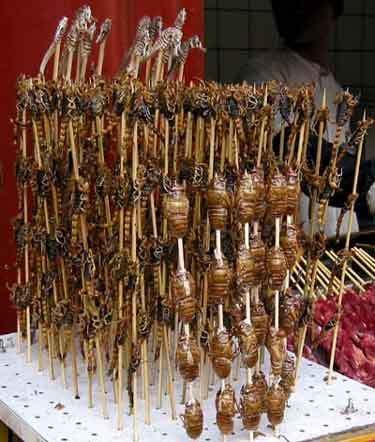
[Insects in a Beijing (China) market in 2004.]
"There are millions of insect species known worldwide. Only 1500 or so are reported edible."
Edible Insects
Insects have played an important part in the history of human nutrition in Africa, Australia, Asia and the Americas. Hundreds of species have been used as human food. Some of the more important groups include grasshoppers, caterpillars, beetle grubs and (sometimes) adults, winged termites (some of which are very large in the tropics), bee, wasp and ant brood (larvae and pupae) as well as winged ants, cicadas, and a variety of aquatic insects.
Ordinarily, insects are not used as emergency food to ward off starvation, but are included as a normal part of the diet throughout the year or when seasonally available.
In Europe the use of insects of foods has always been very limited. Although frequently mentioned in ancient Greek and Roman literature, there are only very few reports on the use of insects as food in later centuries. Only in times of starvation, insects were eaten. The main reason for the difference between Europe and the other continents is that insects are not so abundant and generally much smaller compared to tropical regions.
Recently the use of insects as food has declined in many tropical regions, partly to increased availability of ‘better' foods. This often includes meat and more Western styles of dishes [which is causing huge changes in health in populations unused to eating this European food in Asia; see this book for examples of why:
Why Some Like It Hot: Food, Genes, and Cultural Diversity by Gary Paul Nabhan (2006)
].
As insects are a very good source of nutrients, the question remains whether insects are not actually the better food.
In Africa insects are traded on a large scale and several industries produce canned insects and insect dishes.
On the other hand, in the US and to a lesser extend in Europe, eating insects has increased. However, not as a regular food, but more as a curiosity.
Insects are for example covered in chocolate or offered as sugared candies.
Tequila flavoured candy with worm (source)
Chocolate covered ant candies (source)
Most religions accept insects as normal food and place no restrictions or taboos on consumption of insects. Jewish traditions consider only a few types of insects as kosher. However, in practice, Jews avoid eating insects deliberately, as only trained entomologists may be able to distinguish between kosher and non-kosher insects.
In Muslim regions the use of insects is very restricted. Only grasshoppers are considered halal (allowed to eat), when died a naturally death or killed lawfully. Practically all other insects are considered haram. However, in countries such as India, Indonesia and Malaysia, many different insects are eaten traditionally, even in nominal Islamic regions. In Arab countries only grasshoppers can be found on markets.
As over 1500 different species of insects have been reported as being consumed or edible, this is a too long list to describe in detail. The following pages give some more information on the use of insects as food:
* Classes of edible insects
* Regions and countries
* List of reported species
* Some nutritional data
Classes of edible insects
There are millions of insect species known worldwide. Only 1500 or so are reported edible.
Insects are subdivided in many different orders, groups, genera and species. Below some groups of insects and their use as food are described.
Butterflies and moths (Order Lepidoptera).
The larvae (caterpillars) of many species of moths (and a few species of butterflies) are used as food. They are a particularly important source of nutrition (protein, fat, vitamins and minerals) in Africa. In one country alone, Congo (formerly Zaire), more than 30 species are harvested. Some caterpillars are sold not only in the local village markets, but are shipped on a large scale from one country to another. Caterpillars are canned in Botswana and South Africa. In the rural countryside, they are usually dried in the sun before being sold in the market.
Adult moths and butterflies are not eaten – their wings and bodies are clothed with the small flat scales and hairs that make them so colourful.
A colony of Imbrasia ertli on the base of a Funtumia tree (Congo). The caterpillar descend from the foliage of the tree each time they moult. It is at this stage they are collected for eating. Normally the whole colony is taken and can either be eaten after roasting or boiling or else can be sun dried for later use. (Source)
True bugs (Order Hemiptera).
Most of the insects in this order that are used as food live in water. The famous “Mexican caviar,” or ahuahutle, is composed of the eggs of several species of aquatic Hemiptera; these have formed the basis for aquatic “farming” in Mexico for centuries. One species in Asia, the “giant water bug,” is now exported from Thailand to Asian food shops all over the world.
Thai Giant Water Bug (Lethocerus indicus ), eaten steamed, also ground into a paste with chilli and eaten with sticky rice (Source)
Cicadas (Order Homoptera).
This order includes many insects, such as aphids and leafhoppers, which are important agricultural pests, but only the cicadas are used widely as human food. The nymphs of some species, known as “periodical cicadas,” spend up to 17 years underground where they feed on roots. After 17 years they emerge from the soil, climb up a tree trunk or fence post and molt to the adult stage. Periodical cicadas occur as “broods” which appear above ground only once every several years in any one locality. When they do appear, however, it is often in vast numbers. That is when they are collected as food, sometimes even by school children in the United States. They can be fried. Many cicadas have shorter life cycles, and some of them were collected as food by Indian tribes in what is now the western United States. They are eaten regularly in many other countries, especially in Asia, and some are very large. A cicada from Malaysia even has a wing span of nearly 18 cm!
Brood X, one of the North American periodical cicadas (Magicicada sp.). (Source)
Termites (Order Isoptera).
Termites are most widely used as food in Africa. They are social insects with colonies divided into “castes” that include workers, soldiers, winged adults and a queen. The queen becomes very large and she lays thousands of eggs. Colonies of some species build huge earthen mounds, called termitaria, which may be up to 20 feet high. Periodically, the winged adults emerge in huge swarms, mate while in flight, and then start new colonies. They are highly attracted to lights, even candlelight, and that is one way they are captured for use as food. The wings are broken off, and, fried, termites are delicious. The queens are considered a special treat and are often reserved for children or grandparents.
Termites. (Source)
Bees, ants and wasps (Order Hymenoptera).
With bees and wasps, it is usually the bee or wasp “brood” (larvae/pupae) that is eaten. Most adult bees and wasps don't taste good, but there are exceptions. Canned wasps, wings and all, are sold in Japan, and rice cooked with these wasps was a favourite dish of the late Emperor Hirohito. With ants, it is also the larvae and/or pupae that are usually eaten, but not always. Roasted leafcutter ant abdomens are sold, instead of popcorn, in movie theaters in some places In South America. In some cultures, bee nests are collected as much for their bee grubs as for the honey. In Mexico, certain kinds of ant pupae, known as escamoles, are found on the menu in the finest restaurants. They are served fried with butter, or fried with onions and garlic.
Beetles (Order Coleoptera).
Beetles have complete metamorphosis. Larvae, pupae and/or adults of many species are used as food. Obviously, people do not eat adult beetles whole; the hard parts (wings, legs and head) are removed during preparation for cooking. The larvae (sometimes called “grubs”) are soft-bodied.
Australian tyape arlkerlatye grubs (Source)
Grasshoppers, crickets, etc. (Order Orthoptera).
Grasshoppers and crickets and their relatives have played an important role in the history of human nutrition. Roasting and sautéing are frequently used methods of cooking, after first removing the wings and legs. Seasonings such as onion, garlic, cayenne, chili peppers or soy sauce may be added. Candied grasshoppers, known as inago, are a favourite cocktail snack in Japan .
The inago grashopper (Oxya japonica) (Source)
Spiders and scorpions (Class Arachnida)
Spiders and scorpions are two different orders within the class Arachnida (spider-like organisms), the Aranae (spiders) and the Scorpiones (scorpions). Only a few of the over 40.000 species in this class are eaten.
Scorpions are eaten in the south of China and neighbouring countries. They are reared in ‘ranches', mostly in people's homes, then sold in the markets. Scorpions have a woody taste and should be eaten whole, except for the tip of the tail.
Spiders are also mainly eaten in South-East Asia. In Cambodia large, tarantula like, spiders are still commonly eaten in the North of the country.
Scorpion soup. (Source)
Walking sticks and leaf insects (Order Phasmatodea).
These grotesquely shaped insects are used as food in a few places in Asia and in Papua New Guinea.
The edible Extatosoma tiaratum from Papua New Guinea. (Source)
http://www.food-info.net/uk/products/insects/classes.htm
Adopted from : www.food-insects.com
2.
New, the online book:
"The Human Use of Insects as a Food Resource: A Bibliographic Account in Progress"
Table of Contents and Preface
Chapters 2-28 now online. Please read the Preface to find out how all of this is supposed to unfold.
About the book, and Table of Contents
The Human Use of Insects as a Food Resource: A Bibliographic Account in Progress
Gene R. De Foliart
Professor Emeritus
Department of Entomology
University of Wisconsin-Madison
Table of Contents*
Preface
Part I. Introduction, The Western Hemisphere and Europe
Chapter 1. Introduction (not yet written)
Chapter 2. Insect Foods of North American Indigenous Populations North of Mexico (pp. 1-95)
Chapter 3. The Use of Insects as Food in Mexico (pp. 1-49)
Chapter 4. Central America and Caribbean Islands (pp. 1-11)
Chapter 5. South America: Overview (pp. 1-10)
Chapter 6. South America: Brazil (pp. 1-20)
Chapter 7. South America: Colombia (pp. 1-15)
Chapter 8. Other Countries in South America (pp. 1-23)
Chapter 9. Western Attitudes Toward Insects as Food: Europe, The United States, Canada (pp. 1-40)
Chapter 10. Western Research on Insects as Food and Animal Feedstuffs (pp. 1-30)
Part II. Africa
Chapter 11. Southern Africa: Overview (pp. 1-10)
Chapter 12. Republic of South Africa (pp. 1-22)
Chapter 13. Southern Africa: Zimbabwe (pp. 1-17)
Chapter 14. Other Countries in Southern Africa (pp. 1-16)
Chapter 15. Central and Eastern Africa: Overview (pp. 1-14)
Chapter 16. Central and Eastern Africa: Congo (Kinshasa) (Formerly Zaire) (pp. 1-35)
Chapter 17. Central and Eastern Africa: Zambia (pp. 1-19)
Chapter 18. Central and Eastern Africa: Kenya, Malawi, Tanzania, Uganda (pp. 1-17)
Chapter 19. Central and Eastern Africa: Angola, Congo (Brazzaville), Others (pp. 1-22)
Chapter 20. Northern and Western Africa (pp. 1-30)
Part III. Asia, Oceania
Chapter 21. Southwestern Asia (pp. 1-23)
Chapter 22. South-Central Asia (pp. 1-23)
Chapter 23. Southeastern Asia: Overview [incomplete]
Chapter 24. Southeastern Asia: Thailand (pp. 1-35)
Chapter 25. Other Countries in Southeastern Asia (pp. 1-28)
Chapter 26. Eastern Asia (pp. 1-36)
Chapter 27. Oceania: Overview, Papua New Guinea, Others (pp. 1-20)
Chapter 28. Oceania: Australia (pp. 1-51)
Appendix Chapter 1. General Bionomics: Insect Orders and Families With Complete Metamorphosis
Appendix Chapter 2. General Bionomics: Orders and Families With Incomplete Metamorphosis
Appendix Chapter 3. Potential Hazards with Ingestion of Insects
* Chapters for which page numbers are shown are those so far posted.
Preface
Compilation of the papers found here began in 1975 when the author started preparation of a technical paper on a subject he knew nothing about.
It was to be delivered on the University of Wisconsin campus as part of what organizers were calling "A Workshop on Unconventional Sources of Protein." More details about the workshop will be available later in a book I am preparing, titled, "Insects as a Global Food Resource: The History of Talking About it at the University of Wisconsin."
During the ensuing 27 years (approximately) pertinent references were gathered in fitful spurts, some in connection with research projects but others simply because they pertained to the broader subject of insects as food. From early on, it seemed that the subject warranted a book-length updating of F.S. Bodenheimer's classic Insects as Human Food published in 1951.
Although the goal continued to be eventual publication of a book, the growing assemblage of papers had many immediate uses. It was a resource file not only for research but for a growing outreach effort that included founding The Food Insects Newsletter, introduction of a 1-credit course at the University of Wisconsin-Madison, creation of a traveling exhibit for elementary and middle school students, and responding to increasingly frequent invitations to write review articles or to speak on the subject locally or at meetings of professional organizations in this country and abroad.
Mentioning all this activity, you may have guessed, is an attempt, a weak attempt, perhaps, to explain how easily one can let year after year slip away without completing a particular major goal – like finishing this book.
In 1997 though, my wife, Louise, or "Lou," who was adept on computers, helped me launch an intensive electronic literature search through the University of Wisconsin libraries aimed at pulling in copies of many articles that I had not seen previously. Lou's sudden death, from cardiac arrhythmia, in February 1998 brought this particular stretch of productivity on the book to an abrupt end. After dealing with a variety of new distractions, like learning how to survive on my own cooking (which became possible, actually, by handouts from friends), I again turned attention to what had by now become THE BOOK, a monstrous piece of unfinished business. Getting it out suddenly seemed a matter of greatest urgency, and I resumed work on it early in 2002. One main concern was that all the effort made to obtain and translate numerous French and Spanish language works on the subject not be wasted by continued delay.
By this time I had decided to publish the book on the Internet, for two reasons. One, I was thoroughly disgusted with the high price of science books; two, rather than waiting until all the final details were cleared up (which always takes longer than one expects), I could start posting a few chapters at a time, as they become ready. This more informal approach seemed the best way to ensure that the book might actually become useful to somebody, some time, somewhere. For example, I haven't written Chapter 1, the Introduction, yet. Have you ever seen a book with no Chapter 1? Of course not. Until now. But, with our informal Internet approach, we don't have to hold up 27 other chapters simply because we lack a Chapter 1. It's one of the nice things about the electronic age; we can add an Introduction later, when we get around to it.
In deciding to go with what we have, warts and all, I have tried to provide for future expansion. The title hints at that, ". . . in Progress." Chapters are numbered independently, each chapter beginning with page 1. Tables are listed for most chapters, but, for now, readers will need to consult the original sources if they wish to see the tabular data (table numbers in the original sources are given). Eventually I hope to find time to seek permission from publishers to include the tabular data here. At the end of the References Cited in most chapters, there are additional references under the heading, "Added References." These are references pertinent to the chapter but not cited; it is my hope that soon after we get all existing text online we can start adding abstracts below these titles, and also start adding additional titles. Also, it is my intention, at that time, to invite readers to submit pertinent references of which they are aware but that are not yet listed, and, if possible, to furnish copies (the hills are getting steeper on the UW campus and I no longer have a stable full of young people eager to do legwork to the libraries). We may also be soliciting volunteers willing to translate papers from languages other than English. By then, we might even be soliciting for pertinent photographs, as long as accompanied by adequate data. When the time comes, potential donors should inquire first, before sending material of any kind, in order to avoid duplications. Such inputs from others will be acknowledged, of course, somewhere in the book within a reasonable time.
There are important papers in the "Added References" sections, and readers should consult them where possible in order to be sure of having completely updated information on a country or region. The 1997 work by F. Malaisse, with chapters on the caterpillars, termites and other edible insects of Congo (Kinshaza) (formerly Zaire) is one good example. The three chapters (pp. 198-242) are also a good example of pages needing translation before this author can proceed with abstracting and future incorporation. Another good example is The Edible Insects of China, by Chen Xiaoming, 181 pp. published in 1999, in Chinese, and fortunately for some of us, with an English abstract. Chen lists 177 edible species, far more than will be found in our text on China. Another important recent source under "Added References" is the 1997 special issue of Ecology of Food and Nutrition, titled Minilivestock, edited by M.G. Paoletti and Sandra G.F. Bukkens, with chapters by various authors on a number of countries. In a chapter on Ecuador, a country for which little information was available previously, G. Onore lists 83 edible insect species.
Following the section on "Added References" in some chapters is an additional short section titled, "Items Needing Attention." These are mostly missing bits of information or other problems with the references already included under "References Cited." Here again, after all of the chapters are online, we will turn our attention to these "items needing attention." These are the sorts of dangling details I mentioned above that always take longer to clear up than one expects. Once again, I will probably seek help from readers who have ready access to a particular paper that poses a problem.
Finally, we welcome input from taxonomists who spot errors in our use of names or who can supply the names of species authors where these are missing. Prof. Robert Jeanne and Steven Krauth, Curator of the Entomology Department Insectarium have supplied names already of authors of some species of Hymenoptera.
Our first task now is to finish getting the existing chapter texts up on the website. After that is done we can think about how best to handle additional references and other alterations. Maybe, with help from users we can eventually make this a quite complete collection of papers on this important subject.
Acknowledgments
Although the main business of my laboratory was medical entomology, many individuals in the lab made a contribution to this project at one time or another, in one way or another. This was especially true of the people holding Specialist or lab assistant positions down through the years, assisting in research, doing library searches, formatting the Newsletter, etc., etc.; chronologically, three of the most involved were Marsha Lisitza, Joyce Keesey, and Catherine Howley. Postdoc Christine Merritt was also of great help, especially in rounding up literature. Howley and Merritt both put in many volunteer hours after my retirement and the termination of my medical entomology program with its associated funding. Graduate student research, of course, yielded pertinent literature. Mark Finke and Barbara Nakagaki earned PhDs, while Stephen Landry and Megha Parajulee took Masters' degrees on this subject, before continuing on to PhDs in other entomological specialties. Wives of two graduate students made an immense contribution by furnishing translations, Dianne Landry, who is fluent in French, and Heloisa Scholl, fluent in Spanish.
Moving up to the present time, thanks are due to my son-in-law, David Jansen of Portland, Maine who installed and has maintained this website up to now, with some help on maintenance from his daughter, my granddaughter, Cortney Jansen. I am greatly indebted to two of my Madison neighbors, Laura Herman and Jennifer Stevens, who come to the rescue when I am in trouble on the computer (which is most of the time when I am on the computer). Thanks go to Janet Deutsch, webmaster for the UW Department of Entomology who is helping put this book on the website, and will sometime in the future help shift it to the Entomology Department website or to the General Library System digital collections. I thank Lee Konrad of the Digital Content Group, General Library System and two members of his group, Jean Gilbertson and Jean Ruenger-Hanson, for valuable discussions on handling this as an on-line work. I am indebted to my Entomology Department colleague, Prof. Robert Jeanne, for establishing the contact with the Digital Content Group.
Gene De Foliart
Madison, Wisconsin
June, 2002
Page last update 9/29/02.
http://www.food-insects.com/book7_31/The%20Human%20Use%20of%20Insects%20as%20a%20Food%20Resource.htm
http://www.food-insects.com/
Subscribe to:
Posts (Atom)